سلتك فارغة


المجموع: 2373
/
2373

Inelastic collision of two objects, where a faster and lighter one collides into a slower and heavier one.

Investigating the x and y components of the motion

The car will first accelerate then move with constant velocity

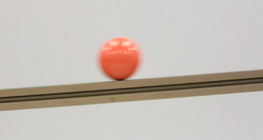
Uniformly accelerated motion if a ball rolling down on inclined planes with different slopes
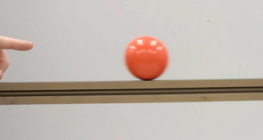
Investigating the horizontal component of the motion
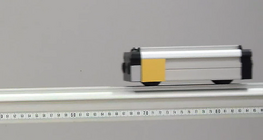
Understanding the concept of acceleration with a negative sign and deceleration
The relationship between acceleration and angles of inclination
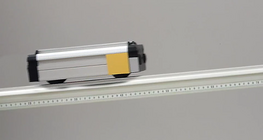
Writing a mathematical formula for function x(t)
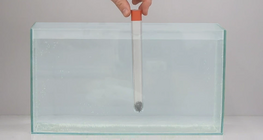
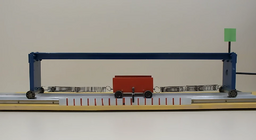
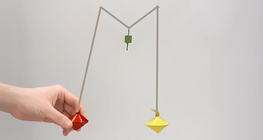
The conditions of resonance and resonance catastrophe.
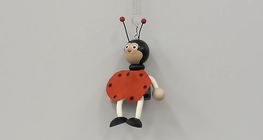
Oscillation of a toy on a spring damped by friction

Oscillation of a toy on a spring damped by air-drag
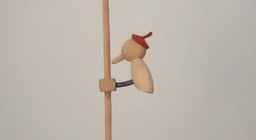
The woodpecker starts to move periodically back and forth and in the meantime it moves slowly downwards the pole

Illustrating the concept of average speed using the position-time and speed-time graphs
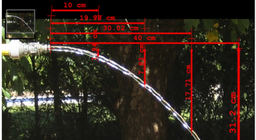
Representing horizontal projection as a complex motion.
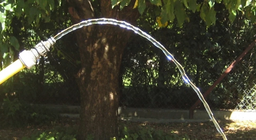
Investigating oblique projection in a Cartesian coordinate system with oblique axes.

Investigating oblique projection in a Cartesian coordinate system with oblique axes.

Introducing new quantities of simple harmonic oscillation through the position-time and velocity-time graphs

Introducing the mathematical formulas for position and velocity. Comparing the motion of the pendulum to the motion of an object on a spring

Showing through experiment that the period does not dependent on amplitude
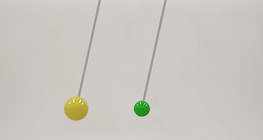
Showing through experiment that the period of a pendulum is not dependent on mass

Demonstrating how period is effected by the pendulum length